THE JOURNEY TO SUSTAINABLE LIVING BEGINS IN YOUR HOME.
With real estate prices in major cities increasingly out of reach for most workers, the dream of owning a home is becoming more and more distant. As rental costs rise without securing long-term assets, the need for stable and sustainable housing solutions is more urgent than ever.
In this trend, social housing is gradually becoming a practical option, helping workers and young families gradually realize their goal of home ownership instead of viewing housing as just a temporary solution.
Social Housing – Differentiated by Support Mechanisms
According to Clause 7, Article 1 of the 2023 Housing Law, 'Social housing is housing with State support for eligible beneficiaries of housing support policies as stipulated in this Law.'
The core difference of social housing lies in the support mechanisms regarding policies and development costs, while construction standards must still fully comply with regulations on planning, design, and construction quality.
This means that social housing today is no longer associated with the concept of 'cheap, low-quality housing,' but rather aims for a stable living environment that meets the long-term living needs of residents.
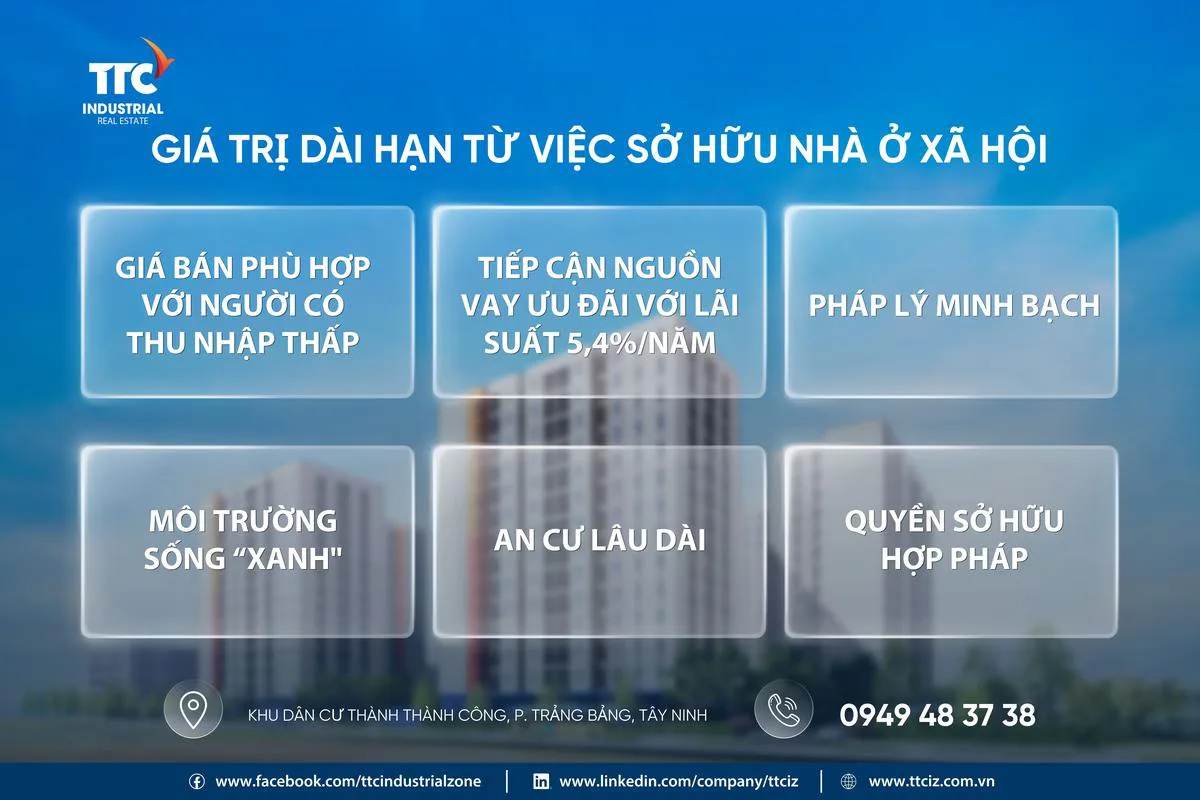
LONG-TERM VALUE FROM OWNING SOCIAL HOUSING
The period of 2026 marks a significant improvement in social housing policies, as the supply continues to expand to meet the growing demand for housing. Owning social housing in general, and social housing in the Thanh Thanh Cong residential area in particular, offers many practical benefits:
- The selling price is affordable for low-income earners, workers, and young families.
- Access preferential loan sources with interest rates of approximately 5.4% per year and terms of up to 25 years.
- Legal transparency is managed according to state planning.
- The living environment is integrated with green spaces and amenities, ensuring security.
- Settling down near your workplace contributes to a more stable life.
- Legal ownership after the transfer restriction period as stipulated.
PROJECT INFORMATION FOR SOCIAL HOUSING IN THANH THANH CONG RESIDENTIAL AREA
Project name: Social housing (high-rise social housing apartment complex) is part of the Thanh Thanh Cong residential area project in Trang Bang ward, Tay Ninh province.
Project developer: Thanh Thanh Cong Industrial Park Joint Stock Company.
Project construction site: Trang Bang Ward, Tay Ninh Province.
Contact address, application submission address: At the headquarters of Thanh Thanh Cong Industrial Park Joint Stock Company, located in Thanh Thanh Cong Industrial Park, Trang Bang Ward, Tay Ninh Province.
Project progress: Construction has commenced, with the pile foundation expected to be completed in September 2026 and the entire project in March 2028.
Project scale:
Land area: 39,700.50 m2 (location of the land plot in Thanh Thanh Cong Residential Area, plot number II-16)
Number of floors: 14
Number of apartments: Comprising 4 blocks A1, A2, B1, B2 (Phase 1 is expected to have 829 apartments)
Application period start and end dates:
Applications will be accepted starting April 3, 2026.
Application deadline: June 26, 2026
Estimated selling price: Approximately VND 17,733,396/m2 to VND 19,511,236/m2 (including VAT and excluding maintenance fees); the specific selling price of each apartment is detailed in the Appendix attached to Decision No. 03A/2026/QD-HDQT dated February 5, 2026, of Thanh Thanh Cong Industrial Park Joint Stock Company.
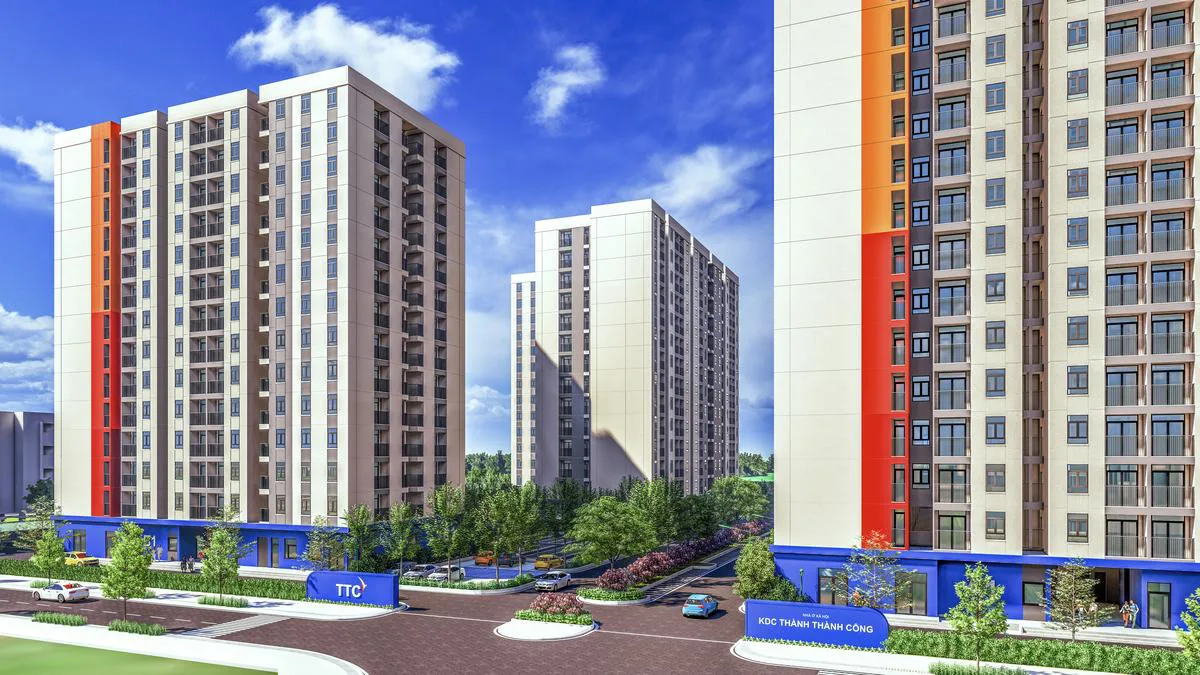
Perspective view of social housing in the TTC residential area (Trang Bang, Tay Ninh), phase 1 is expected to provide 829 apartments.
For readers' convenience in accessing official information, TTC IZ updates the documents related to the social housing project in the Thanh Thanh Cong residential area that have been published by the Department of Construction of Tay Ninh province, including:
(1) Official document announcing information on social housing project No. 3896_SXD_QLNBDS dated April 2, 2026, from the Department of Construction of Tay Ninh province;
(2) Document No. 65/2026/CV-TTCIZ dated March 18, 2026, from Thanh Thanh Cong Industrial Park Joint Stock Company;
(3) Decision No. 03A/2026/QD-HDQT dated February 5, 2026, of the Board of Directors of Thanh Thanh Cong Industrial Park Joint Stock Company.
EXPANDING ELIGIBILITY FOR SOCIAL HOUSING PURCHASES IN 2026
According to the Housing Law of 2023, 10 groups of beneficiaries are eligible for social housing support policies, specifically:
- People who have rendered meritorious services to the revolution and relatives of martyrs are eligible for housing improvement support.
- Poor and near-poor households in rural areas.
- Poor and near-poor households in rural areas frequently affected by natural disasters and climate change.
- Poor and near-poor households in urban areas.
- Low-income people in urban areas.
- Workers and laborers are employed at enterprises, cooperatives, and cooperative unions inside and outside industrial zones.
- Officers, professional soldiers, non-commissioned officers of the People's Armed Forces, police workers, civil servants, defense workers and officials currently serving in the armed forces; cryptography personnel, and other personnel working in cryptography organizations receiving salaries from the state budget (who have not yet received housing support policies for the People's Armed Forces).
- Officials, civil servants, and public employees as defined by the law on officials, civil servants, and public employees.
- The person has returned the public housing as stipulated in Clause 4, Article 125 of the Housing Law, except in cases where the public housing is reclaimed due to violations of the provisions of this Law.
- Households and individuals whose land is subject to expropriation and whose houses must be demolished according to the law, but who have not yet received compensation from the State in the form of housing or land.
Notably, from July 1, 2026, the eligibility criteria for purchasing social housing will be expanded to include families and couples with two or more children, who will be eligible for social housing if they meet the current regulations.
PREPARING FOR A SUSTAINABLE RESETTLEMENT JOURNEY
Proactively researching policies, preparing documents early, and choosing well-planned projects will significantly shorten the home ownership journey for buyers.
With a focus on developing eco-smart industrial parks, TTC IZ not only prioritizes production infrastructure but also aims to build living spaces closely connected to the workforce, creating a foundation for stable housing and long-term development.
Therefore, having a place to live is no longer a distant goal, but a journey that can begin with the right choices today.