After the merger, Ho Chi Minh City has created an incredibly strong integrated industrial space.
On July 17th, at the Business Convention and Exhibition Center (BCEC), the Ho Chi Minh City Department of Industry and Trade organized a seminar titled 'Driving Forces for Industrial Development in Ho Chi Minh City – From Potential to Action'.
Industrial park and logistics infrastructure are needed.
Mr. Bui Ta Hoang Vu, Director of the Department of Industry and Trade of Ho Chi Minh City, said that the industrial and construction sector currently contributes about 30% of the city's GRDP, serving as an important foundation for Ho Chi Minh City to aim for double-digit growth in the coming years. However, Ho Chi Minh City's industry still faces many challenges, including high logistics costs (accounting for 16%-20% of product costs).
Dr. Truong Minh Huy Vu, Director of the Ho Chi Minh City Development Research Institute, recognizes that logistics infrastructure is the biggest bottleneck, especially the Long Thanh – Cai Mep route which is 'disconnected,' as goods from the Tan Uyen and Bau Bang clusters still have to take a roundabout route, incurring high costs and relying on road transport. Therefore, there is a need for immediate investment in a dedicated railway system to serve industry, connecting key production areas to seaports.
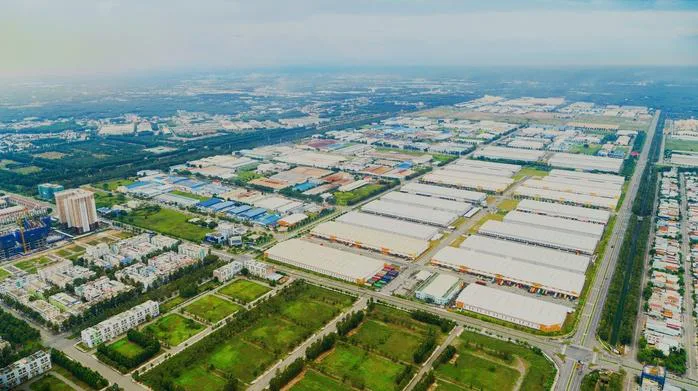 Synchronized and modern industrial park infrastructure is one of the outstanding advantages that helps Ho Chi Minh City strongly attract investment capital.
'Without a multimodal logistics strategy, it will be very difficult for Ho Chi Minh City to achieve double-digit industrial growth,' Dr. Truong Minh Huy Vu observed.
According to a representative of Vietnam Gas Corporation (PV Gas) – a company directly involved in logistics – transporting gas from Thi Vai to Binh Duong (formerly) is very costly and requires better logistics infrastructure. “Ho Chi Minh City could consider developing industrial zones near deep-water ports, which would significantly reduce logistics costs for businesses,” the representative suggested.
From the perspective of a foreign investor, Mr. Arami Hiromasa, General Director of Tosoh Vietnam Polyurethane Company, believes that the merger of Ho Chi Minh City, Binh Duong, and Ba Ria - Vung Tau is very reasonable, helping to increase potential and create more development space, especially making it more attractive to foreign investors. However, Ho Chi Minh City must solve the traffic congestion problem for businesses to feel secure in operating.
'It took me more than 4 hours to travel from Phu My area, Ba Ria - Vung Tau province (formerly) to Binh Duong ward, which is too much time spent in the car!' - Mr. Arami Hiromasa stated the reality.
Close collaboration between the 'three parties'
Speaking at the seminar, Vice Chairman of the Ho Chi Minh City People's Committee Nguyen Loc Ha said that after the merger, the new city not only expanded its development space but also became a 'megacity' with an area of over 6,770 km², a population of over 14 million people, and outstanding economic scale, resources, and potential. This is a golden opportunity for Ho Chi Minh City to maximize its advantages.
According to Mr. Ha, Ho Chi Minh City, Binh Duong, and Ba Ria - Vung Tau previously concentrated nearly 50% of the country's private enterprises; they were leading centers for manufacturing, logistics, and industrial services. However, the proportion of industry in GRDP tends to decrease; traditional industries are still labor-intensive, have low added value, and their competitiveness is not commensurate with their potential.
From there, the Vice Chairman of the Ho Chi Minh City People's Committee emphasized the close linkage between the 'three parties': the state, schools, and businesses. In this linkage, the state creates and establishes the institutional framework, leads investment, creates a favorable environment, and resolves obstacles. Schools are centers providing knowledge, human resources, and a foundation for research, science, and technology. Businesses participate in the research, development, production, and commercialization of products and services, while also providing training orders and sharing resources.
To translate potential into action, the Ho Chi Minh City People's Committee leadership has requested that departments and agencies begin implementing a series of tasks. Specifically, the Department of Industry and Trade proposes appropriate solutions prioritizing the development of foundational industries, high-tech industries, high value-added industries, digital transformation, green transformation, mechanical engineering, chemicals, chips, electronics, semiconductors; and high-speed rail industry… The Department of Science and Technology advises on policies to promote applied research programs, technology transfer, the development of an innovation ecosystem, connecting universities and businesses, and supporting innovative startups. The Department of Finance researches and advises on preferential policies to attract investment in key industries and new technologies, and promotes public-private partnerships…
Meanwhile, Dr. Tran Du Lich, former Director of the Ho Chi Minh City Institute of Economics, argues that if Ho Chi Minh City continues to rely on cheap labor and traditional models, the risk of falling into the middle-income trap is very clear. According to him, new industries must increase value, based on green transformation, digital transformation, and the application of high technology. He suggests that Ho Chi Minh City needs to redistribute its urban space and build an industrial-service-seaport belt.
According to Mr. Tran Du Lich, the expanded space after the merger is an opportunity for Ho Chi Minh City to redraw its industrial development map. With over 8,000 hectares of existing industrial land and 1,000 hectares of high-tech zone, Ho Chi Minh City needs to allocate it rationally instead of concentrating it in the central area.
According to Thanh Thao
workers