According to the Ministry of Planning and Investment, by the end of the third quarter of 2024, total foreign direct investment (FDI) into Vietnam reached nearly US$25 billion, an increase of 11.6% compared to the same period in 2023. In September alone, FDI reached its highest level since the beginning of the year with nearly US$4.3 billion. Of this, real estate, including industrial real estate, ranked second with a total investment of nearly US$4.4 billion, accounting for 17.7% of total registered capital, a 2.2-fold increase compared to the same period last year.
The impetus from foreign capital.
According to the Dat Xanh Real Estate Research Institute (DSX-FERI), the industrial real estate market recorded many positive signs in the third quarter of 2024. In the North, the occupancy rate of industrial parks reached 83%, while in the South this figure was 92%. Notably, the trend of mergers and acquisitions (M&A) and the shift of capital from residential real estate to industrial real estate increased sharply. Some prominent projects include Vinhomes IZ industrial park in Vung Ang with a scale of 965 hectares, and Capitaland's plan to acquire factories and industrial infrastructure with an investment of up to US$110 million.
According to DXS-FERI representatives, the Vietnamese industrial real estate market made significant progress in the third quarter. Stable supply, slightly increased rental prices, and a high occupancy rate reflect sustainable development.
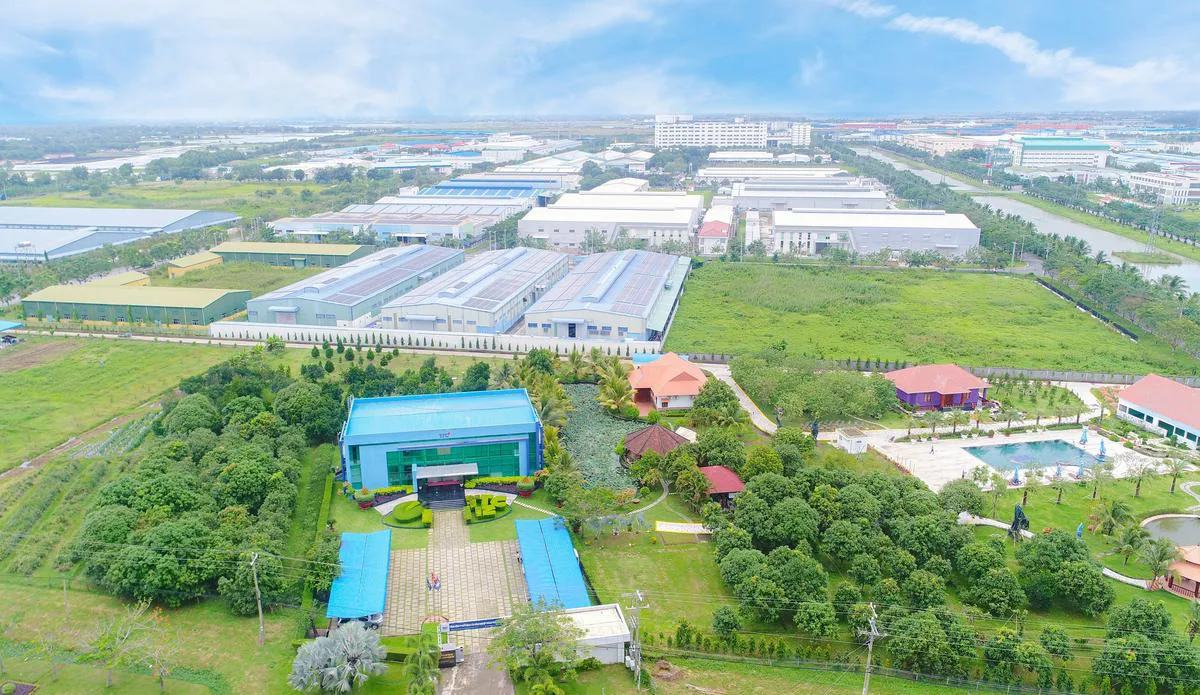
An industrial park of Thanh Thanh Cong Group. Photo: THANH NHAN
According to Knight Frank Vietnam, this year, due to external factors, investors are approaching the market cautiously, but there are still some signs of recovery. In the South, the supply of factory and warehouse space continues to increase; specifically, the area of ready-built factory space increased by 2% (approximately 92,000 m2) and ready-built warehouse space increased by 3% (approximately 174,400 m2) compared to the previous quarter. The improved supply, along with a slight increase in asking rents, shows growing confidence among businesses in the long-term prospects of the market.
The industrial real estate segment also showed signs of growth, reaching a net absorption rate of 83 hectares in Q3, a 14.7% increase compared to Q2 but a 36.6% decrease compared to the same period in 2023. Long An, Ba Ria - Vung Tau, and Binh Duong provinces are emerging as bright spots for investment, attracting many businesses and diverse industries. The development of new industrial parks such as Nam Tan Tap Industrial Park in Long An province is expected to increase the attractiveness of the Southern region.
Mr. Dang Van Thanh, Chairman of the Board of Directors of Thanh Thanh Cong Group (TTC), said the group is preparing for its development strategy for the period 2026-2030, with a vision to 2035. In particular, the industrial real estate sector is receiving special attention to anticipate development trends and attract FDI projects in the manufacturing and warehousing sectors. Mr. Thanh emphasized that factories and warehouses from Singapore and China are gradually relocating to Vietnam, making Vietnam a preferred destination for investors.
According to Mr. Thanh, TTC is finalizing procedures for phase 2 of the Thanh Thanh Cong Industrial Park in Tay Ninh, with a scale of approximately 500 hectares, attracting environmentally friendly industries. Phase 1 of the project, with over 1,000 hectares, has achieved an occupancy rate of over 90%, providing jobs for approximately 40,000 workers.
In addition to Thanh Thanh Cong Industrial Park in Tay Ninh, TTC also owns Tan Kim Expanded Industrial Park in Long An and Tan Hoi Industrial Cluster in Tay Ninh, both strategically located, giving the group a competitive advantage.
Supply will increase in the long term.
According to Avison Young Vietnam, industrial land lease prices in Ho Chi Minh City increased by 5% in the third quarter of 2024 compared to the previous quarter, reaching US$240/m²/term. The main reason is the scarcity of land. Ho Chi Minh City is implementing a plan to convert five existing industrial parks and export processing zones (EPZs), expected to be completed by 2025.
Other localities also recorded notable developments in the third quarter, including the Cay Truong Industrial Park (700 ha) in Binh Duong, the Bau Can - Tan Hiep Industrial Park (phase 1) with 1,000 ha in Dong Nai, and the My Xuan B1-Conac Industrial Park (110 ha) in Ba Ria - Vung Tau. In addition, Long An also attracted significant investment, notably the investment by CW Wind Group of South Korea in a wind power equipment manufacturing plant at the Southeast Asia Industrial Park in Long An.
In the North, Hanoi is actively expanding its industrial land supply with two industrial clusters, Nam Phuc Tho and Long Xuyen, commencing construction in the third quarter. Provinces such as Hung Yen, Thai Nguyen, Hai Duong, Thai Binh, and Thanh Hoa are also accelerating the approval and licensing of new industrial parks, contributing to increased supply in the long term.
According to DXS-FERI's update, the plan for 2024 to 2026 is for the whole country to have approximately 15,000 hectares of land from 23 new industrial parks, including 7 industrial parks in the North, 6 in the Central region, and 10 in the South.
According to David Jackson, General Director of Avison Young Vietnam, the Asia-Pacific region remains a driving force for global development and a safe investment destination, especially in the industrial, residential, office, and hotel real estate segments. “Vietnam will continue to benefit from FDI inflows, especially as new legal regulations are passed and investor confidence continues to strengthen,” the expert stated.
Mr. Vu Minh Chi, Senior Manager of Avison Young Vietnam, believes that in the context of Vietnam's efforts to attract high-quality FDI, efficient energy consumption and commitment to environmental protection will be decisive factors for high-tech investors when considering land leases. Therefore, investors need to improve infrastructure quality and diversify services to increase competitiveness.
Alex Crane, Managing Director of Knight Frank Vietnam, pointed out that although the warehouse market is facing some difficulties due to increased supply and decreased absorption rates, the medium- to long-term outlook for industrial real estate remains very positive, especially in the South, with many high-quality projects and reasonable rental rates. This expert predicts that the industrial real estate market will recover strongly in 2025 as some delayed projects are completed and investor confidence is strengthened.
Investment from China has increased sharply.
Over the past five years, China has not only been Vietnam's leading trading partner but also ranked among the top five countries with the largest amount of investment. In the first seven months of 2024 alone, China led in the number of new investment projects in Vietnam, accounting for nearly 30% and becoming the sixth largest investor among 146 countries and territories investing in Vietnam. Prior to that, in 2023, nearly 20% of newly registered FDI capital came from China.
However, Singapore still leads in total FDI with US$6.52 billion, accounting for 36.2% of total investment and a 79% increase compared to the same period last year. Hong Kong (China) ranks second with US$2.19 billion, double that of last year.
According to The Laborer